For creative strategists and media buyers who save competitor ads and write briefs from them
Foreplay vs Playhead: which one to use
Foreplay and Playhead do two different jobs with competitor ads. Foreplay is a swipe file and ad library: it saves ads from the Meta Ad Library, TikTok and Instagram into boards, searches a community library its pricing page puts at over 200 million ads, and turns saved ads into briefs, from $59 a month. Playhead watches one ad and writes down how it is built: the hook, every beat with its start and length, every claim with the second it is legible, and the cuts. Playhead is free for 50,000 credits a month and the first paid plan is $19. Foreplay finds and keeps the ad. Playhead tells you what happens inside it.
Published 11 min read
The short version
- Foreplay costs $59, $175 or $459 a month, or $49, $149 and $389 on the annual rate, with $20 for each extra user on every plan.
- Foreplay's plan cards list the MCP and API connection on Workflow and Agency, so an agent reaches Foreplay from $175 a month. Playhead's MCP endpoint is on every plan, the free one included.
- The Foreplay API counts 1 credit per ad. A plan includes 10,000 credits a month and 100,000 more cost $99, which is $0.99 for each 1,000 ads.
- Foreplay's own pages give 2 sizes for its ad library: over 200 million on the pricing and MCP pages, over 100 million on the API page.
- Playhead has no ad library and no swipe file. It starts at $0 with 50,000 credits a month and reads any ad from its link.
What is on this page and on no other
Every page about these products carries the same prices and the same feature lists. These are the facts this one produced itself, and how each one was made.
Foreplay's own pages give 2 sizes for one ad library: over 200 million ads on the pricing page and the MCP page, and over 100 million ads on the API page.
Foreplay's Workflow plan tracks 10+ brands on its plan card and 15 brands in the comparison table on the same page, and unlimited brands on the annual rate.
The Foreplay API costs $0.99 for each 1,000 ads at the $99 tier and $0.70 at the $349 tier, with 10,000 ads a month included in every plan.
2 of Foreplay's 3 self-serve plan cards list the MCP and API connection, Workflow at $175 and Agency at $459. The $59 Basic card does not.
What Foreplay is better at
First, because a comparison that opens with our own advantages is an advertisement rather than a comparison.
- A swipe file with boards, tags, ratings, team comments and landing page screenshots, saved from the Meta Ad Library, TikTok, Instagram, LinkedIn and YouTube Shorts with one click.
- A community library that its pricing page puts at over 200 million ads, sortable by how long an ad has run.
- Spyder tracks every ad a competitor launches, with up to 3 years of ad history, from the $175 Workflow plan.
- Briefs, an AI script generator and a storyboard generator, so a saved ad becomes a brief for an editor in the same product.
- Lens connects your own Meta and TikTok ad accounts, with no price step for ad spend on any plan.
How they compare
| What you want | Foreplay | Playhead |
|---|---|---|
Two jobs: keep the ad, and read the ad
Foreplay is where the ad is kept. Playhead is where the ad is taken apart.
A creative strategist does two things with a competitor's ad. First they keep it: save it before it stops running, tag it, put it on a board, share it with the team. Then they read it: play it, pause at each cut, write down what the hook says, when the product appears, how long the proof runs and what the call to action promises.
Foreplay is built for the first job, and it does it well. The extension saves from the Meta Ad Library, TikTok and Instagram with one click, the boards are shared, and a saved ad becomes a brief in the same product.
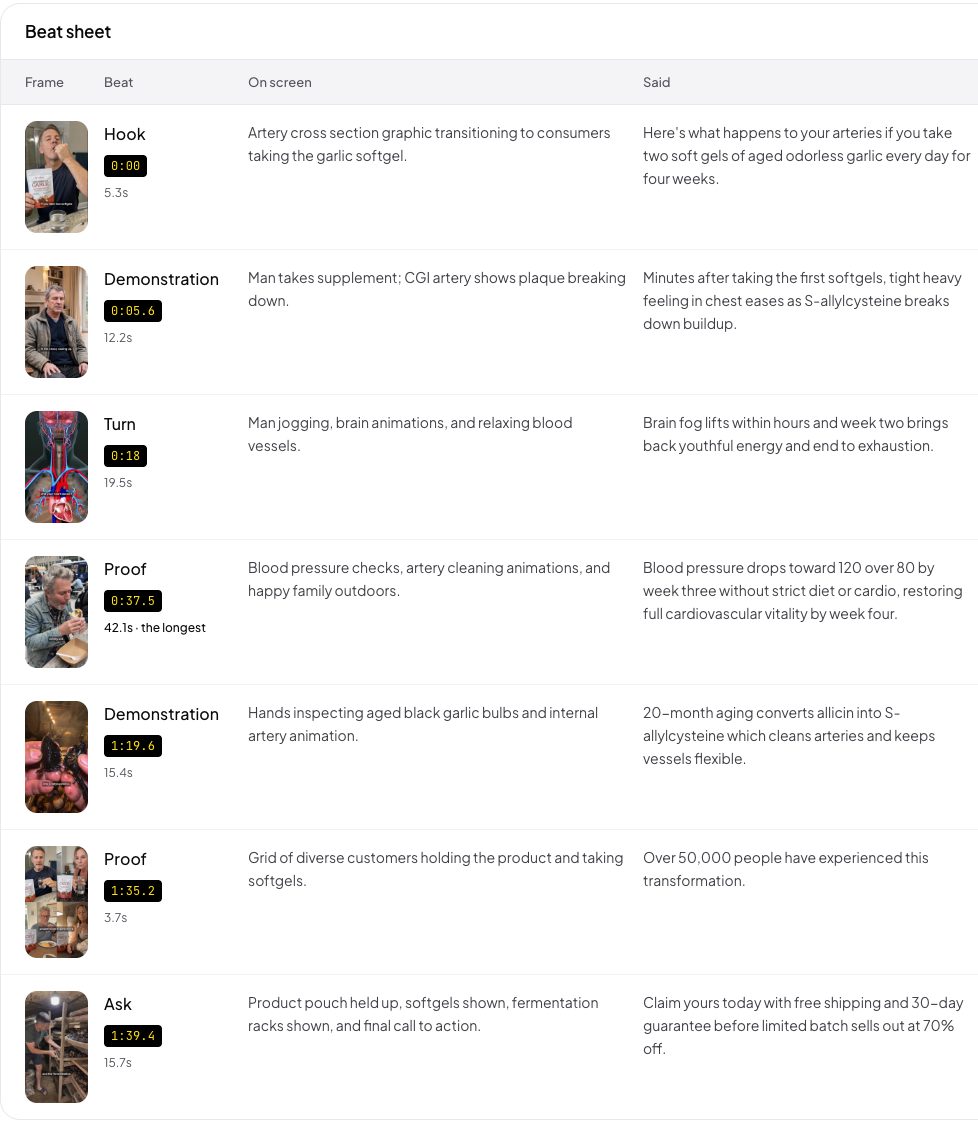
Playhead is built for the second job. Paste the link of one ad, and the answer is a teardown: the hook, every beat with its start and length, every claim quoted with its second, and the cuts counted off the file. That is the hour a strategist spends with the scrubber, and it is the part a swipe file only stores.
What each one costs a month
Foreplay is priced by plan and seat. Playhead is priced by credits.
| Plan | A month | On the annual rate | Users | MCP for an agent |
|---|---|---|---|---|
| Foreplay Basic | $59 | $49 | 1, then $20 each | Not on the card |
| Foreplay Workflow | $175 | $149 | 5, then $20 each | Yes |
| Foreplay Agency | $459 | $389 | 10, then $20 each | Yes |
| Playhead Free | $0 | $0 | 1 | Yes |
| Playhead Creator | $19 | $19 | 3 | Yes |
| Playhead Studio | $109 | $109 | 5 | Yes |
- A team of 5 on Foreplay Basic
- $139/mo
- A team of 5 on Foreplay Workflow
- $175/mo
- A team of 5 on Playhead Studio
- $109/mo
- Foreplay API, per 1,000 ads
- $0.99 to $0.70
Both from inside Claude or ChatGPT
Both publish an MCP server. They answer different questions.
Foreplay's MCP page says an agent can search the ad library, browse your swipe file and boards, and pull a brand's active ads, landing pages and hooks. Every ad comes with the creative, the copy, the call to action, the landing page URL, the live status and how long it has run.
Playhead's MCP server answers the next question: what happens inside that ad. So the two work in one conversation. Ask Foreplay for the longest running video ads of a brand, then give the links to Playhead and ask what the first 3 seconds say, when the offer appears and how long the price is on screen.
The difference in price is the plan it needs. Foreplay's plan cards put the connection on Workflow at $175. Playhead's is on every plan, the free one included.
When to choose Foreplay instead
Choose Foreplay when your team needs one place to save, tag and share competitor ads and turn them into briefs. A searchable library, competitor tracking and a brief builder are the job it is built for, and Playhead does none of the three.
The verdict
Choose Foreplay when the job is to save, organise and share competitor ads and turn them into briefs: the swipe file, the library and Spyder are what it is for, from $59 a month. Choose Playhead when the job is to know what one ad does, second by second: the hook, the beats, the claims and the cuts, from $0 with no card. A team that briefs from competitor ads usually needs both, and the pair costs $78 a month at the entry plans.
Common questions
Is Playhead a Foreplay alternative?
Playhead replaces Foreplay for one job and not for the others. For taking apart a single ad with the second of every beat and claim, Playhead does the job from $0. For saving ads into boards, searching a library of saved ads, tracking competitors and writing briefs, Foreplay does the job and Playhead does not.
How much does Foreplay cost?
Foreplay costs $59 a month for Basic, $175 for Workflow and $459 for Agency, or $49, $149 and $389 on the annual rate, read on 26 September 2026. Each extra user is $20 a month on every plan, and every plan starts with a 7 day free trial.
What does the Foreplay API cost?
The Foreplay API counts 1 credit per ad, and every plan includes 10,000 credits a month. More credits cost $99 for 100,000, $189 for 250,000 and $349 for 500,000 a month, read on the Foreplay API page on 26 September 2026.
Can I use Foreplay and Playhead together?
Yes. Foreplay keeps and finds the ads, and Playhead reads the ones you brief from. Both publish an MCP server, so an agent can pull the longest running ads of a brand from Foreplay and ask Playhead what happens in each one, in the same conversation.
Does Playhead have a swipe file?
No. Playhead keeps every ad you read in your account with its teardown, and you can ask new questions of it later. There are no boards, no browser extension and no library of other people's ads, which is what Foreplay is built for.