For creative strategists and media buyers who study the ads of their competitors
Motion vs Playhead for competitor ad analysis
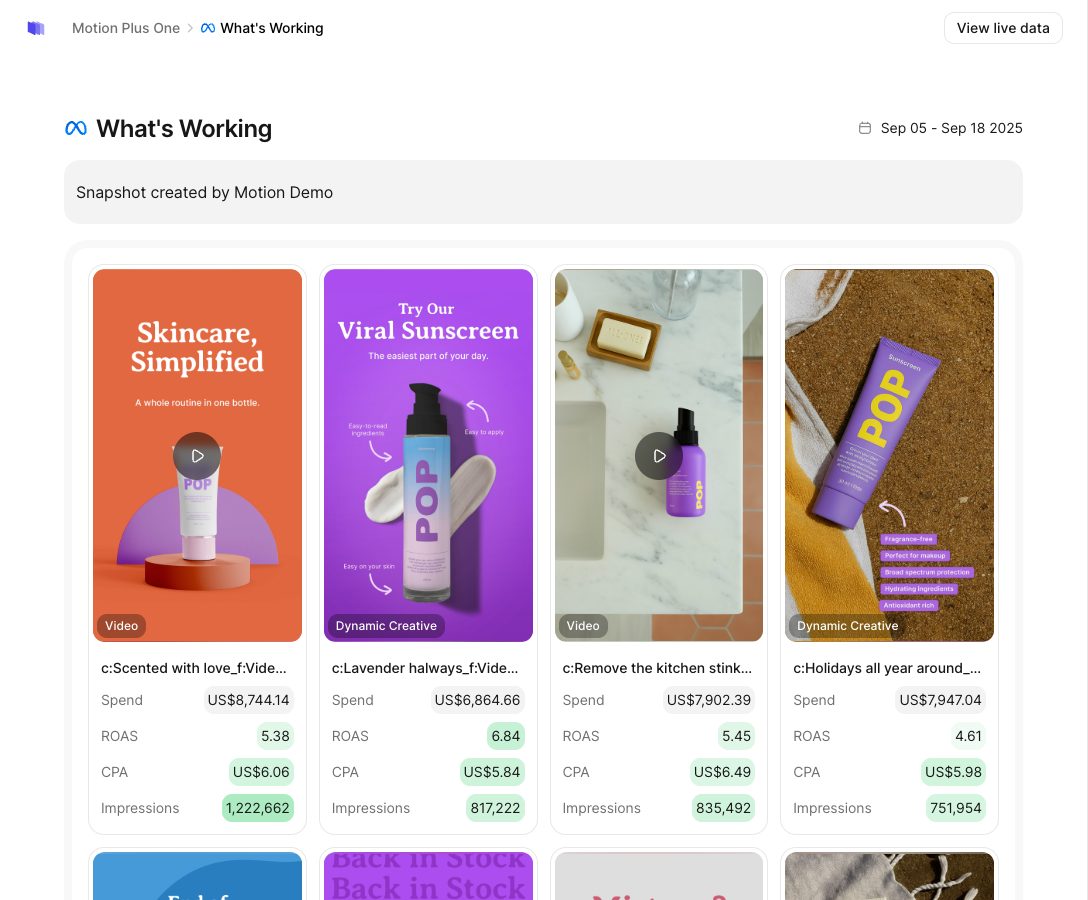
Motion and Playhead answer two different questions about video ads. Motion connects to your ad accounts and shows how your own ads perform: spend, ROAS, CPA and impressions beside every creative, with AI tags across the account. Playhead reads the video itself from a link, so it works on a competitor's ad as well as your own, and it reports how the ad is built with the second of every part: the hook, each beat with its start and length, every claim, the cuts and the pace. Motion starts at $750 a month for up to $50,000 of monthly ad spend, read on 23 September 2026. Playhead starts free with 50,000 credits a month, and the first paid plan is $19.
Published 13 min read
The short version
- Motion's sample report shows 4 numbers under each ad: spend, ROAS, CPA and impressions. None of the 4 says at which second the ad does anything.
- All 3 Motion plans end in a Book a demo button, and the first published price is $750 a month for up to $50,000 of monthly ad spend.
- One shared Playhead teardown of a 115.30 second competitor ad names 7 beats, 33 cuts, 6 quoted claims and the product on screen at 0:01.5.
- Playhead needs no ad account, because it reads the video from its link. Motion reads the accounts you connect, with unlimited seats and unlimited ad accounts on every plan.
- Playhead is free for 50,000 credits a month and the first paid plan is $19, which is 39 times less than Motion's first plan at $750.
What is on this page and on no other
Every page about these products carries the same prices and the same feature lists. These are the facts this one produced itself, and how each one was made.
Motion's public sample report shows 4 numbers under each of its ads, spend, ROAS, CPA and impressions, and not one second of any ad.
All 3 Motion plans end in a Book a demo button, and the first price on the page is $750 a month for up to $50,000 of monthly ad spend.
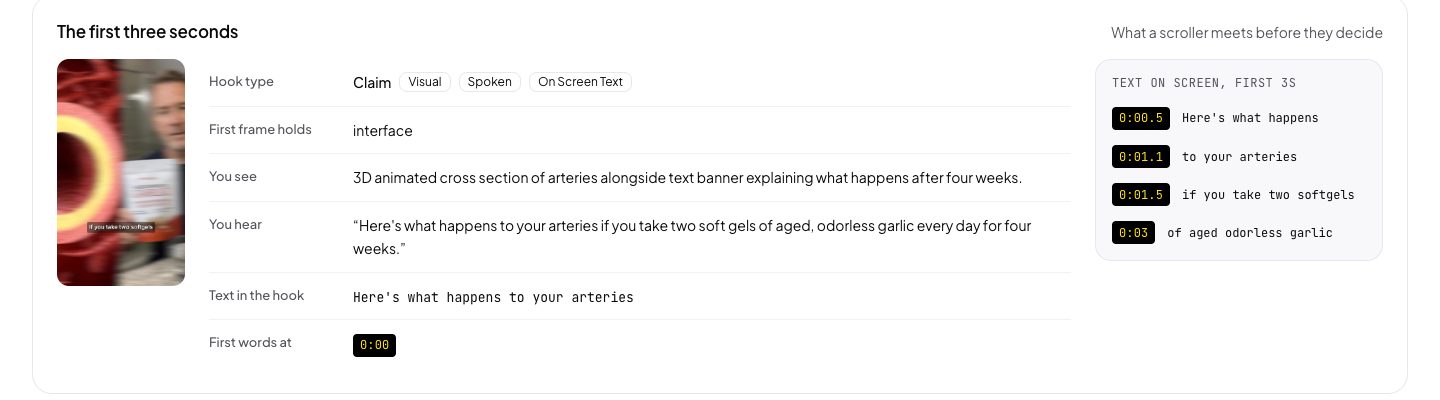
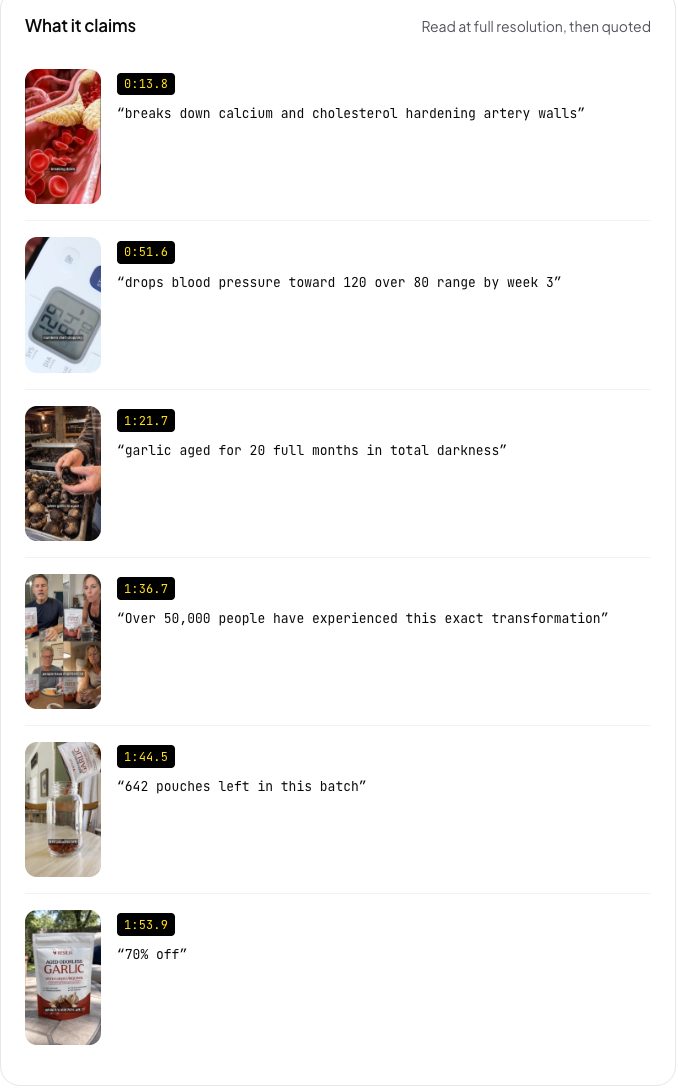
A 115.30 second competitor ad, taken apart by Playhead, has 33 cuts at 0.29 a second, a median shot of 2.9 s, 7 beats and 6 quoted claims, with the product on screen at 0:01.5.
The longest beat of that ad is the proof, 42.1 seconds from 0:37.5, which is 37 per cent of the runtime.
What Motion is better at
First, because a comparison that opens with our own advantages is an advertisement rather than a comparison.
- Performance data beside every creative. Spend, ROAS, CPA and impressions come from your own ad accounts, and a video file holds none of those.
- AI tags across the whole account: asset type, visual format, hook and creative angle, so trends show over weeks rather than ad by ad.
- Unlimited seats and unlimited ad accounts on every plan, and attribution from Northbeam and Google Analytics on the Pro plan.
- An agent that tracks the ads competitors launch and builds a plan to beat them, according to their home page.
- Scale. Their home page says 2,100 teams use it and that customers analyse over $14 billion of media spend a year.
How they compare
| What you want | Motion | Playhead |
|---|---|---|
Two tools, two different questions
Motion answers which of your ads earn their spend. Playhead answers how an ad is built, whoever made it.
Motion is creative analytics. You connect your ad accounts, and Motion pulls in every creative you have run with the numbers beside it. Its public sample report is the clearest picture of what that means: a grid of ads, and under each one the spend, the ROAS, the CPA and the impressions.
Playhead is competitor ad analysis. You paste a link to any video ad, and Playhead watches it and writes down how it is built. The hook and how it reaches a viewer. Every beat, with its start and its length. Every claim, quoted at the second it is legible. The cuts and the pace, counted off the file.
The difference decides which ads each one can read. Motion reads the ads in accounts you connect. A competitor does not connect their account to your workspace, so their ads reach you as links, and a link is what Playhead reads.

One competitor ad, taken apart
A 115.30 second direct response ad for a garlic supplement, read from its link with no account behind it.
The whole teardown is public at tryplayhead.com/ads/resilia-garlic-axbrfw, so every number below can be checked against the page it came from. Every other shared teardown is listed under ad teardowns.
- Runtime
- 115.30 s
- Cuts
- 33, 0.29 a second
- Product on screen
- 0:01.5
- Beats
- 7
- Claims
- 6
- Works with the sound off
- Yes

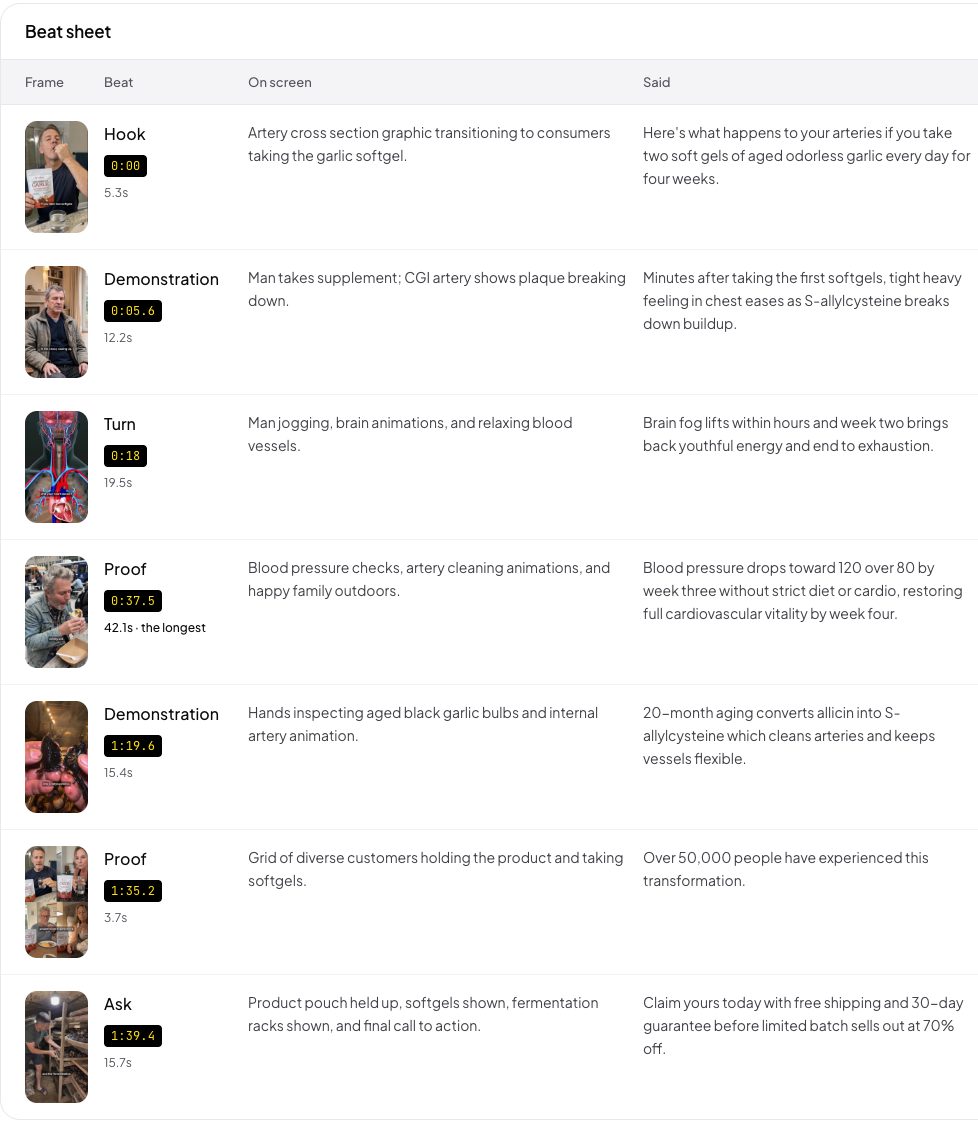
Hook, 0:00, 5.3 s. Here's what happens to your arteries if you take two soft gels of aged odorless garlic every day for four weeks. Demonstration, 0:05.6, 12.2 s. Minutes after taking the first softgels, tight heavy feeling in chest eases as S-allylcysteine breaks down buildup. Turn, 0:18, 19.5 s. Brain fog lifts within hours and week two brings back youthful energy and end to exhaustion. Proof, 0:37.5, 42.1 s. Blood pressure drops toward 120 over 80 by week three without strict diet or cardio, restoring full cardiovascular vitality by week four. Demonstration, 1:19.6, 15.4 s. 20-month aging converts allicin into S-allylcysteine which cleans arteries and keeps vessels flexible. Proof, 1:35.2, 3.7 s. Over 50,000 people have experienced this transformation. Ask, 1:39.4, 15.7 s. Claim yours today with free shipping and 30-day guarantee before limited batch sells out at 70% off.
What each one costs
Both price pages read on 23 September 2026.
| Motion | Playhead | |
|---|---|---|
| Free | A 14-day trial | 50,000 credits a month, no card |
| First paid plan | $750, up to $50,000 ad spend | $19, Creator |
| Second plan | $1,200, over $50,000 ad spend | $39, Pro |
| Largest plan | Growth, no published price | $109, Studio, 5 seats |
| Seats | Unlimited on every plan | 3 on Creator and Pro, 5 on Studio, then $29 each |
| How to start | Book a demo | Paste an ad, no account |
The two prices follow two different things. Motion is sized by the ad spend of the accounts you connect. Playhead is sized by the video you read: an analysis costs credits, and the four ads on our home page cost 5,710 credits together as one set.
Take apart a competitor's ad yourself
Paste one ad from the Meta Ad Library, TikTok or Instagram. The first analyses need no account.
When to choose Motion instead
Choose Motion when your brand spends $50,000 or more a month on paid social and the question is which of your own ads earn their spend. Reports of your own account with ROAS beside every creative are the job it is built for, and Playhead does not do that job.
The verdict
Choose Motion when you spend $50,000 or more a month on paid social and need reports of your own accounts with ROAS beside every creative. Choose Playhead when the ads you study are not yours: a competitor's reel, a Meta Ad Library entry, a TikTok. Playhead takes each one apart with the second of every beat and claim, starts at $0, and asks for no ad account and no demo.
Common questions
Is Playhead an alternative to Motion?
Playhead replaces Motion for one job and not for the other. For taking apart a video ad, a competitor's included, with the second of every beat and claim, Playhead does the job from $0. For reports of your own ad accounts with spend and ROAS beside each ad, Motion does the job and Playhead does not.
Can Motion analyse a competitor's ads?
Motion's home page, read on 23 September 2026, says its AI agent tracks the ads your biggest rivals launch and builds a plan to beat them. What a single competitor ad is broken into, and whether each part carries a second, is not published on their home page or their pricing page.
Does Playhead need access to my ad account?
No. Playhead reads the video from its link or from a file you upload, so no ad account is connected. That is also why Playhead cannot show spend, ROAS or CPA: a video file holds none of those numbers.
How much does Motion cost compared with Playhead?
Motion starts at $750 a month for up to $50,000 of monthly ad spend and costs $1,200 a month above that, read on 23 September 2026. Playhead is free for 50,000 credits a month, and the paid plans are $19, $39 and $109 a month.
Can I use both?
Yes, and the two do not overlap much. Motion tells you which of your own ads earn their spend. Playhead takes apart the competitor ads you find, in the Meta Ad Library or on TikTok, so a brief for the next ad can name the hook, the beat order and the pace it borrows.