A Facebook competitor analysis has 6 steps. Open the Meta Ad Library, pick a country and search the competitor's Page. Filter to active video ads. For each ad, record the start date, the number of versions, the platforms and the landing page, because an ad that runs for 30 days or more is an ad somebody keeps paying for. Then watch each ad and write down the hook, the second the product appears, the offer, the proof and the call to action. Put the ads side by side and look for what repeats. The Ad Library is free and shows no spend or results for a commercial ad, so the analysis is about what the competitor runs, not about how much it sells.
Key takeaways
- Start in the Meta Ad Library. It is free, needs no account, and shows every active ad of a Page.
- Record 8 fields per ad. 4 come from the Ad Library card, and 4 you can only get by watching the ad.
- Four ads of one supplement brand, Resilia, ran from 28.8 to 164.9 seconds and cut between 0.14 and 0.55 times a second. One brand does not have one style.
- Of 7 tools beside the Ad Library, entry prices run from $0 to $750 a month, and only 2 print a free plan on the pricing page.
- No tool shows a competitor's spend or sales for a commercial ad. Read what they run and how long they run it.
What is on this page and on no other
Most pages on this subject repeat the same advice and the same figures. These are the facts this one produced itself, and how each one was made.
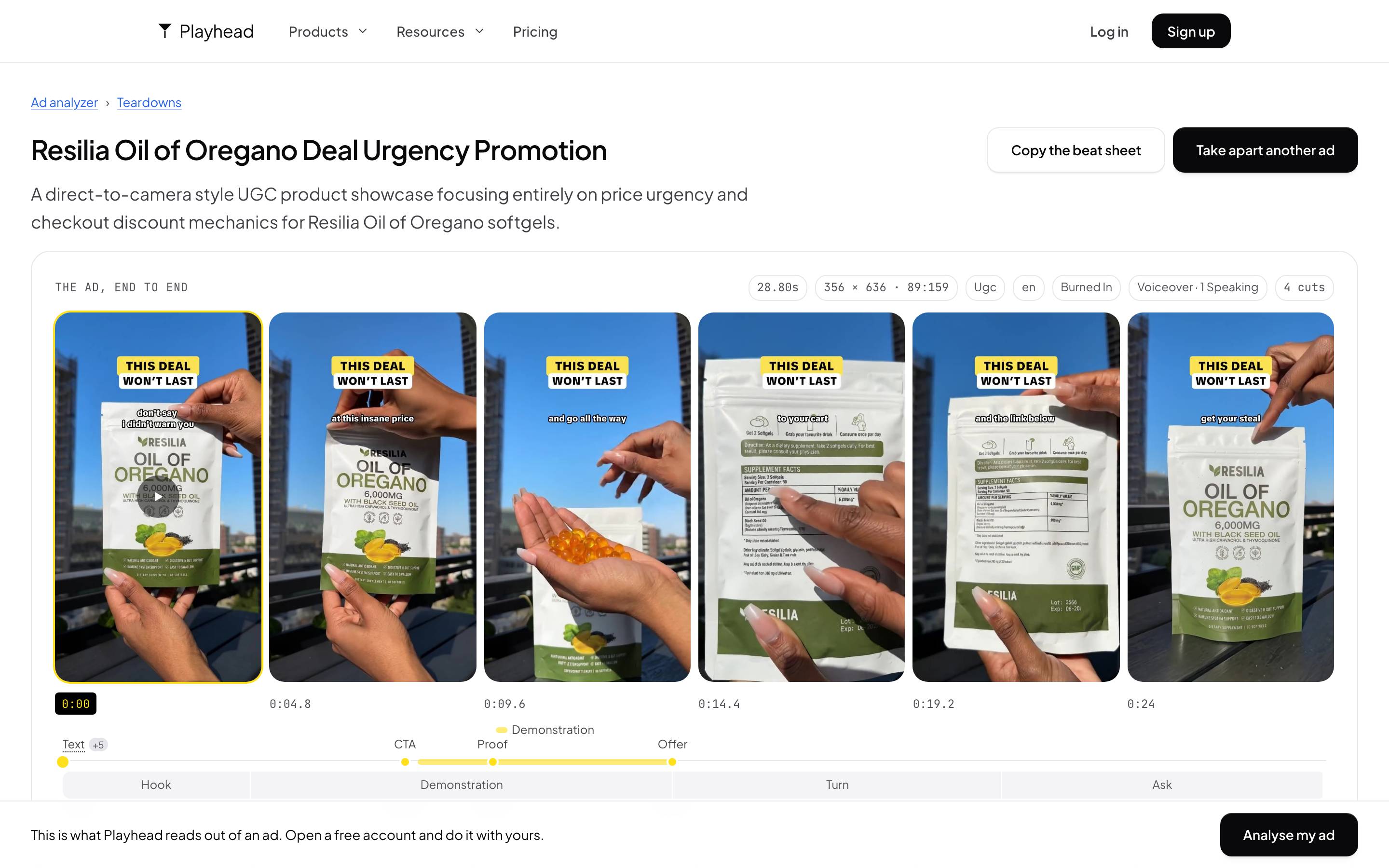
Four public teardowns of one supplement brand, Resilia, show four different ads: 28.8 to 164.9 seconds long, 4 to 91 cuts, the product on screen at 0.6, 0.6, 1.5 and 5.1 seconds, and 3 different kinds of hook. All 4 work with the sound off.
The call to action of the same 4 ads stays legible for 2.0, 3.5, 6.1 and 6.3 seconds, and the ads name 3 to 6 claims each. The shortest ad has the fewest cuts, 4 in 28.8 seconds.
Of 7 competitor ad tools beside the free Ad Library, the entry price runs from $0 to $750 a month. 2 print a free plan (BigSpy and Playhead), and 3 print the size of their ad database, from more than 10 million (Minea) to 212.2 million (AdSpy).
How to do a Facebook competitor analysis
Six steps, one competitor, one sheet. The first three are free and take about 20 minutes.
Open the Meta Ad Library and find the Page
Go to facebook.com/ads/library. Pick a country and the category All ads. Type the brand and choose its Page from the list, so that you see only that Page's ads. Pick an EU country when the brand sells there, because an ad that reached the EU stays in the library for 1 year after it stops.
Filter to the ads that matter
Under Filters, set Media type to Videos and Active status to Active ads. Add Platform when you only buy on Instagram or on Facebook. Now the list holds what the competitor pays for today.
Record the 4 fields on each card
Copy the Library ID, the date in "Started running on", the number in "N ads use this creative and text", and the platforms. Then open the ad and copy the landing page address. An ad that started 30 or more days ago and still runs is an ad that pays for itself, or a test nobody stopped.
Watch each ad and record 4 more fields
Write down the hook in the first 3 seconds, the second the product first appears, the offer, and the call to action with its words. Add the proof the ad shows: a review, a number, a demonstration, a person who uses it. These 4 fields are not on the card. You get them only from the video.
Put the ads side by side
One row per ad, one column per field. Look down each column. What repeats across the ads that run longest is the part the competitor has tested. What appears once is a test.
Repeat it every month
Search the same Page again 30 days later. The ads that are gone lost. The ads that are still there won, and the new ones show what the competitor tests next.
The 8 fields to record for each ad
Four from the card, four from the video. The second four are where the analysis is.
| Field | Where you get it | What it tells you |
|---|---|---|
| Start date | Ad Library card, "Started running on" | How long the competitor has paid for the ad |
| Versions | Ad Library card, "N ads use this creative and text" | Whether the ad is scaled into more ad sets |
| Platforms | Ad Library card | Where the competitor thinks the buyer is |
| Landing page | The link in the ad | What the ad sells, and what the page promises |
| Hook | The first 3 seconds of the video | Why a person stops scrolling |
| Product on screen | The video | How long the viewer waits to see what it is |
| Offer and proof | The video | The reason to buy now, and the reason to believe it |
| Call to action | The last seconds of the video | What the viewer must do, and for how long it is on screen |
Write the seconds down, not only the words. "The product appears early" cannot be compared across ads. "The product appears at 0.6 seconds" can, and so can "the call to action is legible for 6.1 seconds". Our ad swipe file template holds the same fields, ready to copy.
How to read the ad itself: one brand, four ads
The card says how long an ad runs. Only the video says why it might work.
Here is the analysis on a real advertiser. Four ads for Resilia supplements, one of them titled Vresilia, are on our public shelf of ad teardowns. Each one was read second by second and shared on purpose. Put side by side, they show the thing a competitor analysis looks for: what stays the same across the set, and what changes.
What stays the same. All 4 work with the sound off, because every word is in captions or headline text. 3 of the 4 show the product by 1.5 seconds.
What changes. The length runs from 28.8 to 164.9 seconds. The hooks are of 3 kinds: a pain, a relatable scene twice, and a claim. The animated explainer cuts 91 times, and the urgency ad cuts 4 times. So this brand tests the format, and keeps the captions and the early product.
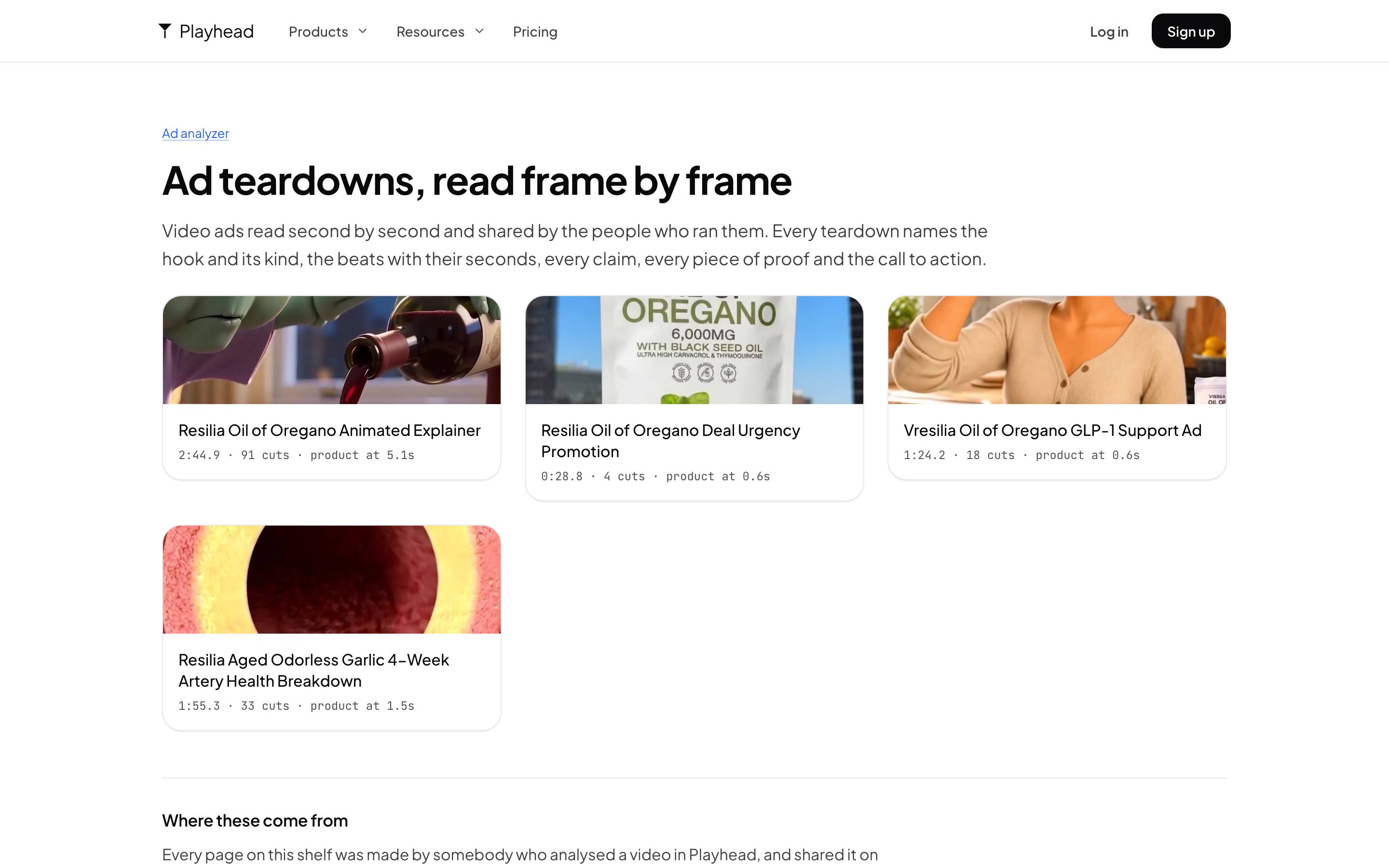
Cuts per 10 seconds in 4 ads of one brand
| Ad | Length | Hook | Product on screen | Call to action legible |
|---|---|---|---|---|
| Deal urgency promotion | 28.8 s | Pain | 0.6 s | 6.1 s, "Click the link below" |
| GLP-1 support | 84.2 s | Relatable | 0.6 s | 6.3 s, a 30 day risk-free trial |
| Garlic artery health | 115.3 s | Claim | 1.5 s | 3.5 s, "while it's still 70% off" |
| Animated explainer | 164.9 s | Relatable | 5.1 s | 2.0 s, "grab it before they sell out" |
Facebook ads competitor analysis tools
Two jobs: find the ads, and read them. Most tools do the first job.
A competitor analysis tool does one of two jobs. A library tool finds and keeps ads: it searches a database, follows brands and saves ads to boards. A reader takes one ad and says what happens in it, second by second. The Meta Ad Library is the free library everybody starts with. Every price below comes from the vendor's own page on 9 October 2026, and every row names a limit, ours too.
| Tool | From | What it does | The limit |
|---|---|---|---|
| Meta Ad Library | Free | Every active ad of a Page, with start date and versions. No account needed. | No spend or results for a commercial ad, no saving, no analysis of the video. |
| Foreplay | $59 a month | Swipe file, a search of more than 200 million ads, briefs. Spyder tracks competitors from the $175 plan. | Competitor tracking is not on the $59 plan. 7 day trial, no free plan. |
| Atria | $129 a month, billed yearly | Follows 50 brands on Core, extracts video scripts, AI concepts and an MCP server. | $159 a month when paid monthly. Core follows brands with no AI insights. |
| AdSpy | $149 a month | Search of 212.2 million ads in 88 languages and 225 countries, with comment search. | One price on the home page. Search, not a reading of the ad. |
| BigSpy | Free, then $69 a month | 11 ad channels in 80 or more countries. 20 creative downloads a day on the free plan. | Built to find ads. The page names no analysis of what happens in a video. |
| Minea | $49 a month | Meta ads and products listing, 10 AI analyses of an ad a month on Starter. Shops start on Premium at $99. | Built for product research for shops. 10 ad analyses a month on the entry plan. |
| Motion | $750 a month | Pre-watches and tags every creative in your connected ad account. | Reads your own account. A competitor's ad is outside what it reports on. |
| Playhead | Free, then $19 every 4 weeks | Reads one ad from a link: hook, beats with seconds, claims, offer, proof, call to action. | No ad database and no tracker. You bring the link from the Ad Library or a tool above. |
Sources: Foreplay pricing, Atria pricing, AdSpy, BigSpy, Minea pricing, Motion pricing and Playhead pricing, all read on 9 October 2026.
Which one to pick. Start with the Ad Library and a sheet. Buy a library tool when you follow more than about 5 competitors and want the ads kept after they stop. Use a reader when the question is why an ad works, because no database answers that. Motion is on this list because Atria's list puts it there, and it is the right tool for your own account, not for a competitor's.
The verdict
A Facebook competitor analysis needs no paid tool to start. The Meta Ad Library gives you every active ad of a Page, its start date and its versions, for free. The work that tells you something is the second half: watching each ad and writing down the hook, the second the product appears, the offer, the proof and the call to action. Four ads of one brand ran from 28.8 to 164.9 seconds and cut 4 to 91 times, so one ad never stands for a competitor. Read the set, then decide which tool saves you the hours.
Common questions
How do I see my competitors' Facebook ads?
Open facebook.com/ads/library, pick a country and the category All ads, and type the competitor's brand. Choose its Page from the list to see only its ads. The library is free, needs no account, and shows every ad the Page runs today on Facebook, Instagram, Messenger, Audience Network, WhatsApp and Threads.
Can I see how much a competitor spends on Facebook ads?
Not for a commercial ad. The Meta Ad Library shows spend only for ads about social issues, elections or politics. For an ad that reached the EU it shows reach. The best free signal for a commercial ad is how long it runs and how many versions of it run, because an advertiser stops paying for an ad that loses.
How do I know which competitor ads are working?
Look at two fields on the Ad Library card. "Started running on" 30 or more days ago, on an ad that is still active, means somebody keeps paying for it. "N ads use this creative and text" above 1 means the ad is scaled into more ad sets. Neither one proves sales, and both are better than a guess.
What should I record in a competitor ad analysis?
Eight fields per ad: the start date, the number of versions, the platforms and the landing page from the card, and the hook, the second the product appears, the offer with its proof, and the call to action from the video. Write seconds, not adjectives, so that two ads can be compared on the same field.
Is there a free Facebook competitor analysis tool?
The Meta Ad Library is free and has no limit. Of the 7 other tools on this page, BigSpy and Playhead print a free plan: BigSpy with 20 creative downloads a day, Playhead with 50,000 credits every 4 weeks for reading ads. The others start at $49 to $750 a month, some with a trial.
How often should I run a competitor analysis?
Once a month is enough for most brands. Search the same Pages again after 30 days and compare the list with your sheet. Ads that are gone stopped working for that advertiser. Ads that are still there passed another month, and new ads show what the competitor tests next.