For dropshippers and new store owners who pick products to test
Find winning products in the Facebook Ad Library
To find a winning product in the Facebook Ad Library, look for an ad that has run for 30 days or more, uses the same creative in 3 or more versions, and sends people to a store that sells one product line. A store rarely pays for a losing ad for a month. Then check the margin: the product's price divided by its profit per sale is the ROAS the ad must reach to break even, so a 50 per cent margin needs 2.0 and a 25 per cent margin needs 4.0. Last, read the ad itself second by second, because the product wins with that ad and not with any ad.
Published 8 min read
The short version
- The Ad Library is free, needs no account, and shows every active ad on Facebook and Instagram.
- An ad that has run 30 days or more, in 3 or more versions of one creative, is the strongest free signal that a product sells.
- Meta keeps an ad that reached the EU for 1 year after its last impression, so an EU country filter shows the ads a store already stopped.
- Break-even ROAS is price divided by profit per sale. At a 50 per cent margin it is 2.0, at 25 per cent it is 4.0.
- A product wins with one ad. Read that ad second by second before you copy the product, or you copy half of what worked.
What is on this page and on no other
Every page about these products carries the same prices and the same feature lists. These are the facts this one produced itself, and how each one was made.
4 free signals in the Ad Library point at a product that sells: a start date 30 or more days back, 3 or more versions of one creative, an ad that is still active, and a link to a single product store.
The break-even ROAS of a product doubles when its margin halves: 2.0 at a 50 per cent margin, 4.0 at 25 per cent, and 1.43 at 70 per cent.
An example product that sells at $39.99 and costs $18.00 to land, ship and charge has a profit of $21.99 a sale and a break-even ROAS of 1.82.
The 4 signals that a product sells
Each one is a field the Ad Library shows on every ad, free and without an account.
| Signal | Where it is | What it tells you |
|---|---|---|
| Started 30 or more days ago | "Started running on" on the ad card | A store rarely keeps paying for a losing ad for a month |
| 3 or more versions of one creative | "ads use this creative and text" on the card | The store puts more budget behind the same idea |
| Still active | The Active status filter | The ad still earns its spend today |
| A single product store behind it | The link on the ad, then the store | The store lives on this product, so the product has to sell |
The method, step by step
About 30 minutes for a list of 10 candidate products.
Open the Ad Library and choose All ads
Go to facebook.com/ads/library. Choose a country and the All ads category. No account is needed.
Search by a problem, not a product
Type the words a buyer uses: "back pain", "dog hair", "frizzy hair". Put a phrase in quotes to match it exactly. Add "free shipping" or "50% off" to find direct response ads.
Filter to active video ads
Set the status to active and the media type to video. A product that sells today has a video running today.
Keep the ads with 2 or more signals
Note the start date and the number of versions on each card. Keep an ad that started 30 or more days ago and runs in 3 or more versions.
Open the store behind it
Follow the ad's link. A store with one product line lives on it. For a Shopify store, the best-selling sort and the product JSON give the price and the launch date.
Look at the ads it stopped
Set the country to an EU country. Meta keeps an ad that reached the EU for 1 year after its last impression, so the store's tests that lost are there too.
Read the winning ad second by second
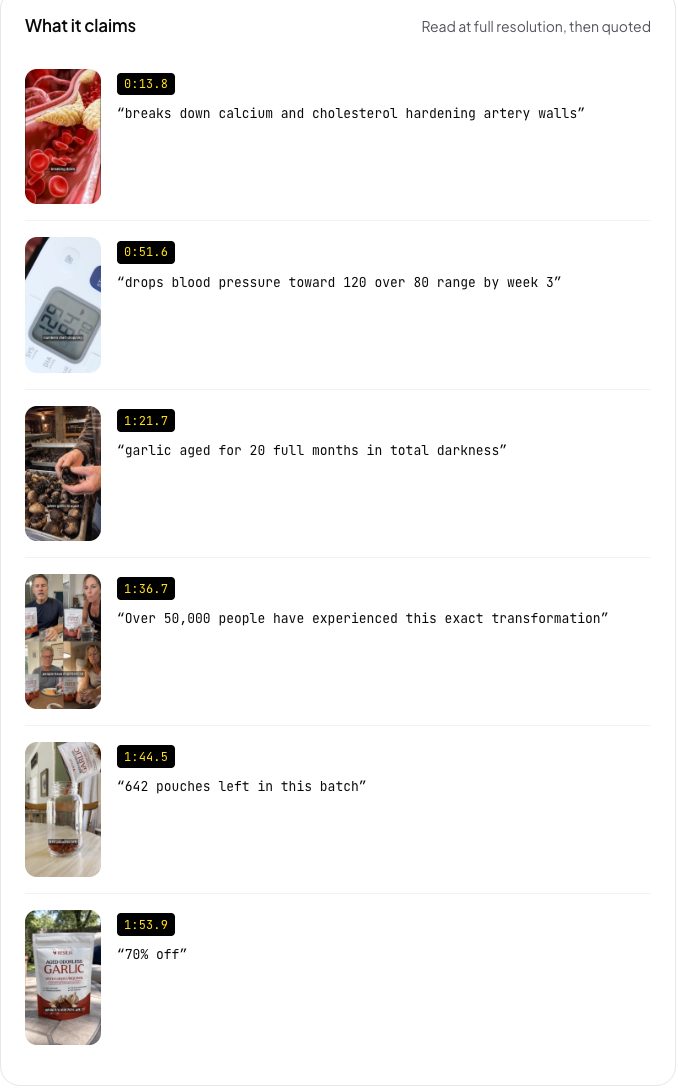
Paste the ad into Playhead. The answer names the hook, every beat with its start and length, every claim at the second it is legible, and the second the product first appears.
The margin test, before you spend a dollar on ads
A product that sells for somebody else can still lose money for you.
A product wins when its ads return more than they cost. The line is the break-even ROAS: the revenue each ad dollar has to bring back before you make any profit.
Break-even ROAS = price ÷ profit per sale, where profit per sale is the price minus the product, the shipping and the payment fee. Take an example product that sells at $39.99 and costs $18.00 to land, ship and charge. The profit is $21.99, and the break-even ROAS is 39.99 ÷ 21.99, which is 1.82. Every ad has to return $1.82 for each $1 it costs before the product earns anything.
| Margin | Break-even ROAS | What it means |
|---|---|---|
| 25 per cent | 4.00 | Hard. Few cold ads return 4 times their cost |
| 33 per cent | 3.00 | Possible with an ad that already works |
| 50 per cent | 2.00 | The usual floor for a dropshipping product |
| 60 per cent | 1.67 | Room to test 3 or 4 new ads |
| 70 per cent | 1.43 | Room to learn while you pay for traffic |
Why the ad matters more than the product
The product that wins in the Ad Library wins with one ad.
Two stores sell the same product, and one of them wins. The product is the same. The ad is not: what the first 3 seconds show, when the product first appears, how long the demonstration runs, what claim is on screen, and whether the ad works with the sound off.
So the last step is not optional. Paste up to 10 ads for the same product into one Playhead set, the long-running ones and the ones that stopped. The same fields come back for each, and the rows where the winners agree are the brief for your own ad.
The verdict
The Facebook Ad Library is the best free product research tool there is, because the paid Meta ad tools read from it. Use 4 signals, keep a product that shows 2 or more, and test its margin before you test its ads: at 50 per cent the break-even ROAS is 2.0, at 25 per cent it is 4.0. Then do the step most people skip. Read the winning ad second by second in Playhead, because a product wins with one ad, and a copy of the product without that ad is half a copy.
Common questions
How do I use the Facebook Ad Library to find winning products?
Search the Ad Library by a problem a buyer has, filter to active video ads, and keep the ads that started 30 or more days ago and run in 3 or more versions of one creative. Then open the store behind each ad and check that the product's margin allows a break-even ROAS you can reach.
What makes a winning product?
A winning product solves a problem a buyer can see in 3 seconds of video, sells at a margin of about 50 per cent or more, and has an ad that has run for 30 days or more. At a 50 per cent margin the break-even ROAS is 2.0, which a working ad can reach.
Can I find winning products for free?
Yes. Meta's Ad Library is free and needs no account, and a Shopify store shows its best sellers and product data on its own public pages. Playhead's free plan adds 50,000 credits a month to read the ads you find second by second.
How long should an ad run before I call it a winner?
Use 30 days as the floor. A store rarely keeps paying for a losing ad for a month, so an ad that started 30 or more days ago and is still active is the strongest free signal the Ad Library gives.
How do I see ads a store has already stopped?
Set the Ad Library's country filter to an EU country. Meta keeps an ad that reached the EU for 1 year after its last impression, so a store's stopped tests are still there, with their reach.